
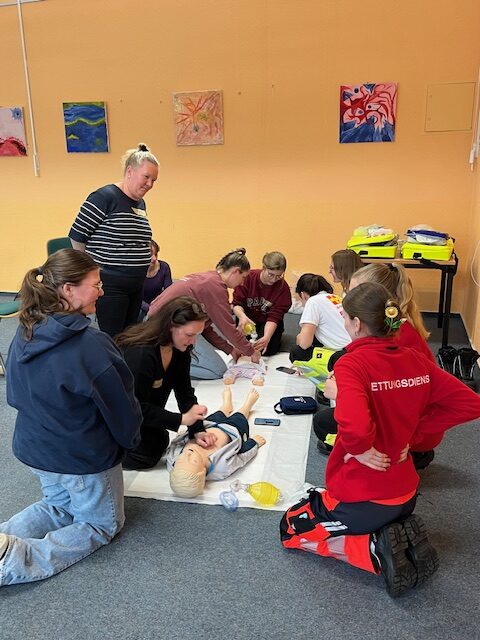
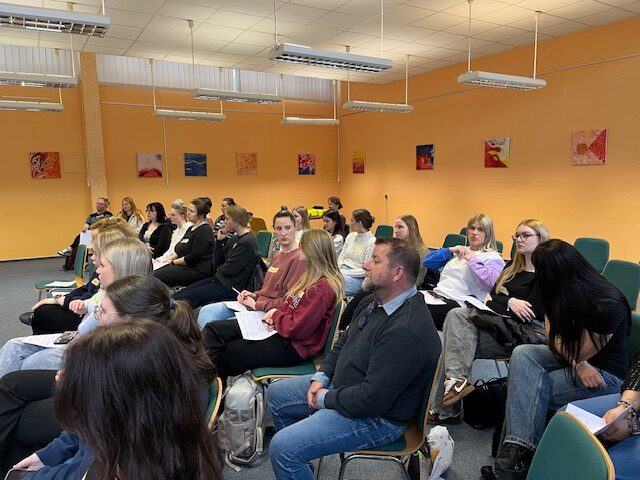
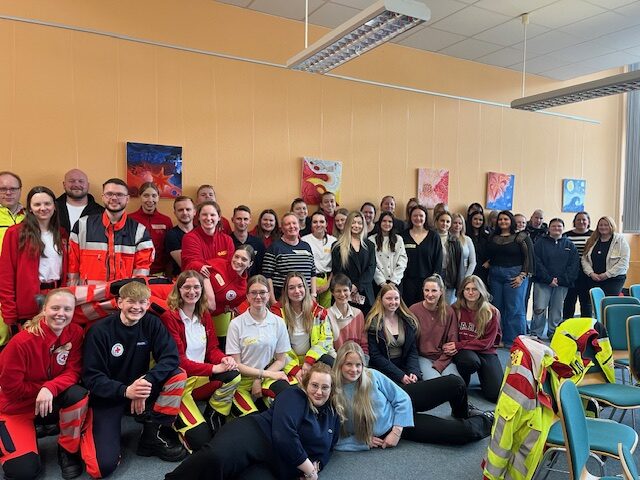
Schon zum zweiten Mal haben die angehenden medizinischen Fachangestellten und die zukünftigen Notfallsanitäter*innen sich zusammengetan und an zwei Unterrichtstage lang zusammen und voneinander gelernt: Das erste Ausbildungsjahr NFS und das zweite Ausbildungsjahr MFA erlebten gemeinsam das Notfalltraining, das zum Lernfeld 5 gehört und die Schülerinnen und Schüler dazu befähigt, in Notfallsituationen richtig zu handeln. Für alle Beteiligten waren es zwei sehr konstruktive und lehrreiche Tage!
Mit dabei war auch Taru. Sie kam über das Erasmus+-Programm und war für vier Wochen als Praktikantin hier in Greifswald. Da sie Schülerin unserer Partnerschule EKAMI in Kotka ist und dort eine Ausbildung zur Pflegfachkraft macht, hat sie bei uns die MFA und NFS besucht. Zusätzlich hat sie bei Ora Cura in die Einrichtungen reingeschaut.
Über ihre Erlebnisse beim Notfalltraining hat sie einen Text geschrieben (auf Englisch natürlich), der anschaulich zeigt, wie eindrucksvoll das Notfalltraining war:
“As soon as I arrived on Wednesday, I was assigned as a practice patient, and the students bandaged a large bleeding wound on my head. Next, I was lying on the ground as a victim of an accident and had to be moved without moving my spine or neck. The students put me on a stretcher, put a neck brace on me, and moved me to the vacuum mattress, where I could only move my toes and eyes. The rest of day I watched the students perform various first aid situations that can be encountered in an ambulance, like heart or asthma attacks, and in each case the paramedics acted as the situation required.
On Thursday the paramedics held a practical demonstration on first aid situations for the medical assistants. I was able to revive a baby, child, and adult doll with the group, to place a breathing tube in the nose and throat and inject an adrenaline pen, to check a person’s vital signs, and to treat large wounds and broken bones. The paramedic students were really brave and confident despite their young age.
The students also practiced in a simulation ambulance in case a birth takes place somewhere other than in a hospital. There was a pregnant doll in the ambulance who was supposed to give birth to a baby doll. There were various problematic situations, such as a baby having the umbilical cord around her the neck, or a lifeless baby. The students were guided by an experienced midwife. Later, the students also practiced caring for a real child patient. The teacher had brought her own child, who is about four years old, with her. It’s a completely different thing to practice taking care of a real person! The child simulated having an asthma attack and a broken ankle. Wow, how brave and dashing was that child!”